A Forum for Vigorous Debate, Cornerstone of Democracy

***********************************************************************************************************************************
A FORUM FOR FREEDOM OF SPEECH AND VIGOROUS DEBATE, CORNERSTONES OF DEMOCRACY
[For the journal--guidelines, focus, etc.--go to www.theamericandissident.org. If you have questions, please contact me at todslone@hotmail.com. Comments are NOT moderated (i.e., CENSORED)!]
Encouraged censorship and self-censorship seem to have become popular in America today. Those who censor others, not just self, tend to favor the term "moderate," as opposed to "censor" and "moderation" to "censorship." But that doesn't change what they do. They still act as Little Caesars or Big Brother protectors of the thin-skinned. Democracy, however, demands a tough populace, not so easily offended. On this blog, and to buck the trend of censorship, banning, and ostracizing, comments are NEVER "moderated." Rarely (almost NEVER) do the targets of these blog entries respond in an effort to defend themselves with cogent counter-argumentation. This blog is testimony to how little academics, poets, critics, newspaper editors, cartoonists, political hacks, cultural council apparatchiks, librarians et al appreciate VIGOROUS DEBATE, cornerstone of democracy. Clearly, far too many of them could likely prosper just fine in places like communist China and Cuba or Saudi Arabia, Qatar, and Russia, not to mention Sweden, England, and Austria.
ISSUE #47 PUBLISHED MAY 2024. NOW SEEKING SUBMISSIONS FOR ISSUE #48.

More P. Maudit cartoons (and essays) at Global Free Press: http://www.globalfreepress.org
Showing posts with label Chris Busa. Show all posts

Wednesday, March 31, 2021

Margaret Murphy Fine Arts Work Center of Provincetown

≥≥≥≥≥≥≥≥≥≥≥≥≥≥≥≥≥≥≥≥≥≥≥≥≥≥≥≥≥≥≥≥≥≥≥≥≥≥

Open Letter to Margaret Murphy, Interim Exec., Director, Fine Arts Work Center  

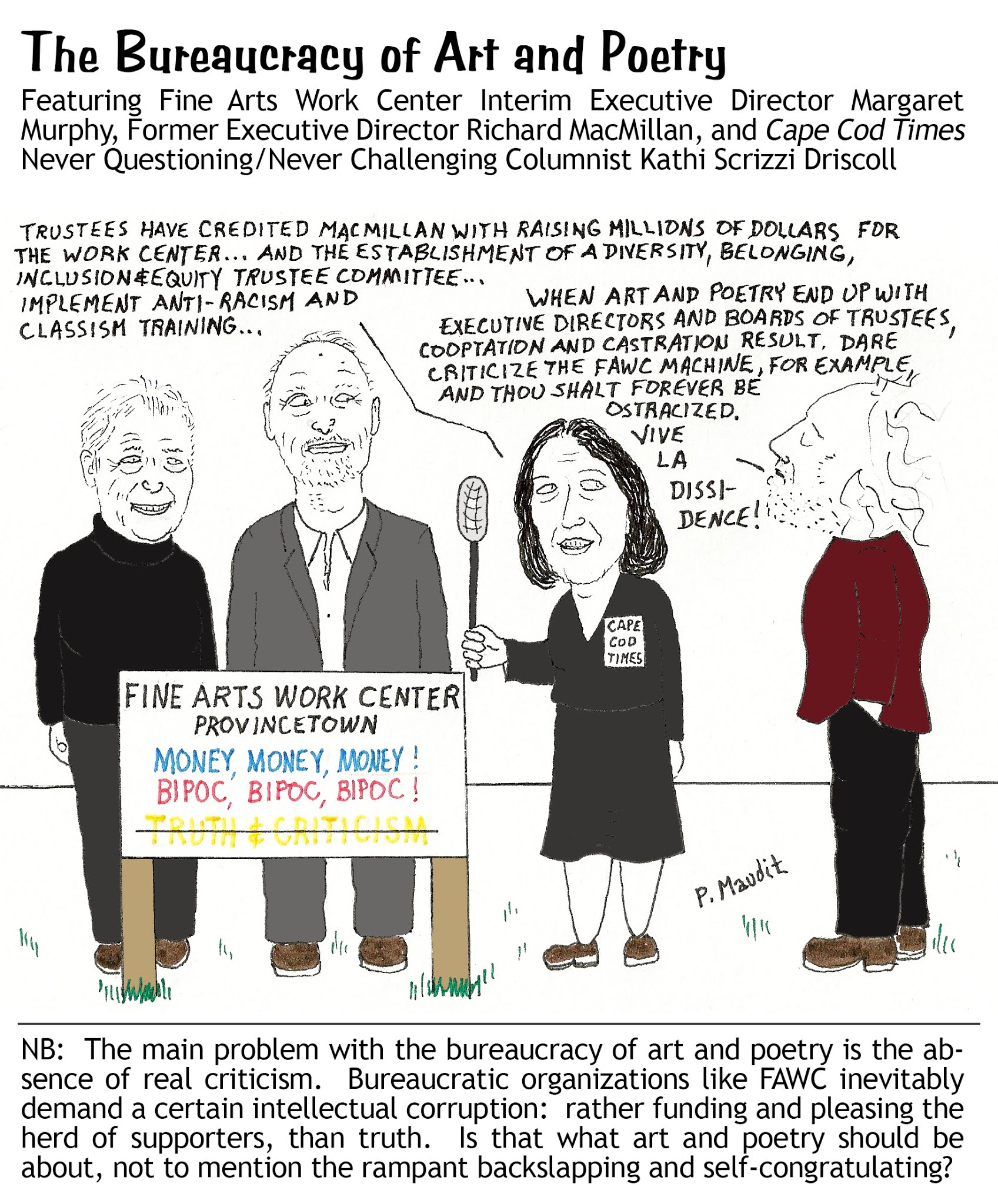
“Words, words, words,” had written French poet Léo Ferré.  And so in the Cape Cod Times, we have “words, words, words.”  Columnist Kathi Scrizzi Driscoll’s article, “Leadership changes at Provincetown arts center as it renews diversity commitment," is indeed “words, words, words”:  money, money, money… and racism, racism, racism!  Might that summarize the arts and poetry today on ole Cape Cod?  Driscoll notes, “[FAWC] Trustees have credited [Exec. Dir. Richard] MacMillan with raising millions of dollars for the work center that will help stabilize its future.”   Stabilize or rather monetize?  And should art and poetry be stabilized?  

Driscoll notes, “The nationally known work center, founded by artists and writers, was one of just two Cape Cod institutions—the Provincetown Art Association and Museum was the other—to win a grant in the National Endowment for the Arts’ first round of $27.5 million funding for 2021.  Money, money, money! On the other note, Driscoll echoes FAWC officials “will continue to develop long-term efforts toward ensuring that every member of our community feels safe, supported, heard and valued.”  Every member EXCEPT, of course, he or she who dares criticize FAWC!  “How dare you!” had said the teenager.  As an example, I have actually dared… not to adorn the usual artist/poet-sheep conformist money-begging attire and have actually stood up to criticize FAWC and its publicist, the Cape Cod Times.  Would FAWC ever offer me a fellowship?  No way, Jose!  OMG, did I just commit the crime of cultural linguistic appropriation? 

In today’s politically-correct society, boasting efforts of inclusion and diversity inevitably ends up meaning efforts of exclusion and uniformity—thou shalt be in-lockstep with the reigning ideology!  Moreover, when art and poetry end up with executive directors and boards of trustees, art and poetry ineluctably end up coopted, castrated, and corralled… in the name of inclusion and diversity.  Artists and poets end up adopting the sad modus operandi of backslapping and self-congratulating… due to the inevitable absence (i.e., exclusion) of real criticism.   And without such criticism, improvement is likely never going to really happen.  

Silence tends to be, apart from ad hominem, the only defense for those in power positions, including executive directors and museum curators (censors).  FAWC never responded to the criticism I sent over the past decade and a half.  Ah, but FAWC publicist Provincetown Arts’ Executive Editor Chris Busa responded, though not at all intelligently:  


“Silly Slone, I was trained in literary studies during a decade in graduate school with some of the foremost critics of the time. Your idea of criticism, from the shrillness of your rants, excludes any sense of illumination. Please do not contact me again.”  

Apparently, those “foremost critics” failed to teach Busa how to grow a spine and respond with reason and facts.  Power positions inevitably demand a certain intellectual corruption:  rather funding and pleasing the herd of supporters, than truth—rude truth.  Is that what art and poetry should be about?  Methinks no; youthinks yes…


Open Wide

(A Poem for Margaret Murphy)


In general, it seems, 

people don’t think; 

they just swallow. 


In general, it seems,

artists, writers, and 

their executive directors

don’t think; they just swallow…


…………………………………………………………………………………….

NB:  Sent to FAWC Margaret Murphy, Richard MacMillan, Kirsten Andersen, Bob Bailey, Susan Blood, Naya Bricher, Kelle Groom, Jennifer Jean, Gemma Leghorn, and the columnist in question.  No response received…


Wednesday, February 5, 2020

Mary Gannon CLMP

..................................................................

The above cartoon I sketched a year ago.  For some reason, the editor of Provincetown Arts, Chris Busa, who HATES debate and alt-opinions, sent me an email yesterday (2/4/2020) with the Subject:  "{Virus?} RE: Mary Gannon featured in a new essay and P. Maudit cartoon."  No message was included with the exception of "This is a message from the MailScanner E-Mail Virus Protection Service. The original e-mail attachment "8119-17893_City_Report.doc" was believed to be infected by a virus and has been replaced by this warning message [,,,]"

So, thanks to Busa I just posted the cartoon and also sent him the following message:  "Yes, definitely a VIRUS, one that will mortally affect your very limited ability to deal with hardcore reality criticism!  By the way, I am not at all violent.  I do not bite.  Ah, but I am a critic, not a publicist disguised as a critic. Do you understand the difference?  Probably and sadly, you likely do not. Anyhow, good to hear from you."

One must wonder how such frail characters like Busa manage to become editors.  Anyhow...

...............................................
Notes from the Literary Landscape:  Hot Air in the Blimp
A Review of an “Interview” (i.e., Literary Advertisement)
The writing establishment was perhaps best reflected by Poets & Writers magazine (P$W), which incarnated perhaps better than any other periodical, even more so than Poetry, the corporate  carcinoma.   For a critic like me, it would be difficult to find just one noteworthy article or interview in any issue of P$W not begging for the sledgehammer.   Indeed, the magazine had proven to be an excellent source of grist.
In its latest issue, my attention was drawn to a photograph of an authoritarian-looking woman, glowing in self-contented grandeur—Mary Gannon, former associate director and director of content for the Academy of American Poets.  In the world of poetry, euphemism had a particularly foul odor.  What was a director of content, after all, if not a director of censorship, a Minerva-goddess gatekeeper?  As an example, the Academy censored (removed) my comments and essentially banned me from expressing my point of view on its publicly-funded website.  The term “censorship” seemed not to have lost its negative tinge, which explained the euphemisms, moderation and director of content. 
Today, Gannon was the new executive director of the Community of Literary Magazines and Presses (CLMP).  Prior to her stint at the Academy, she had been editorial director of… P&W and was (surprise!) married to its current editor-in-chief Kevin Larimer.  Had the interviewer, Cat Richardson, editor-in-chief of Bodega magazine (“Your literary corner store”), somehow presented an objective and critical interview or just another thinly-disguised promotional advertisement?  Imagine if Cat had posed a few tough (i.e., uncomfortable) questions.  Would Larimer have published her interview of his wife?  
So, keep it clean, Cat!  Keep it banal, Cat!  Keep it lit-as-usual, Cat!  And, of course, Cat had no problem at all doing that.  “What is CLMP’s most important role?” was the first question she asked Gannon, who responded:   
Our main role is to help raise the organizational capacity of literary magazines and presses and to support them in whatever way that they need. 
Now, what did “organizational capacity” mean?  Likely, it was corporate-speak for money potential.  CLMP’s website seemed to highlight money and presented CLMP as a publishing business, where membership fees, dues, and more dues form the key to its existence.  
CLMP offers membership to publishers in three categories: Full, Associate, and Chapbook/Zine Publisher.  What all CLMP publishers have in common is a focus on publishing literature and a commitment to doing so ethically.  
What did publishing literature “ethically” even mean?  Was it ethical to publish praise of ones wife?  Or was that a kind of unethical nepotism?  Was it ethical to criticize CLMP and its diverse literary apparatchiks, those self-appointed gatekeepers of ethics?  Was it ethical to buffer an organization spewing nebulous terms like “ethics” and “literary democracy,” as in “Support literary democracy donate to CLMP!”  But what was “literary democracy”?  Sounded nice!  But the reality—the reality of those like Gannon and Larimer—was of course not so nice and not so democratic, but rather undemocratic censorship, banning and ostracizing of those who dared go against the grain of the literary establishment.  It was one of support for poets and writers who chose literary careerism over freedom of expression.
Gannon not only looked like an executive apparatchik, but she talked like one:  “Intentional communication is a really valuable thing to help facilitate.”  Now, what did that mean?  Clearly, my critique was a concrete example of “intentional communication,” but would Gannon help facilitate it?  Would her husband publish it?  Oh, yeah, I forgot fees and dues.  
We want to continue to make those spaces on a national level for members to collaborate, leverage one another’s strengths, and work toward this higher goal of making sure that literature thrives.
In fact, everything Gannon said in Cat’s rather short interview demanded clarification, if not outright challenge.  Sadly, Cat failed royally in that endeavor.  What kind of literature did Gannon want to survive?  Smiley-face lit?  PC lit?  See-no-evil/hear-no-evil lit?  Hagiography lit like the kind her husband adored?  Certainly!  But what about lit that sledgehammered that kind of lit with hardcore, no-holds-barred, unapproved criticism?  Certainly not!  
Cat then posed question #2:  “What are the most significant needs of small presses and literary magazines right now?”  Before I examined the response, I contemplated a possible answer regarding the literary journal I published:  finding rare poets and writers who dared stand up and write against the academic/literary establishment, its icons and organizations… including CLMP.  Now, how did Gannon respond to the question?  Money, money, money?  Well, yes:  “distribution” and “fund-raising.”  Sure, distribution was nice, but I’d reached the point of not really giving a damn about it.  Truth telling.  That was the prime objective of my magazine, not getting on the shelves of Barnes & Nobles and all the libraries that knee-jerk rejected it.  That was certainly something that a businesswoman like Gannon likely could not grasp.  And how sad it was when business (corporate) mentalities took control of poetry and art.  I read through the blather, through her blather, the vacuous elation, and of course the obligatory terms “inclusive” and “diversity” eventually formed part of it. 
Having said that, it’s also a really exciting time for independent and small publishing, because in the wake of the conglomeration of big publishers, it has created space for innovative, dedicated people to put together these projects that connect writers with audiences and make sure that literature is inclusive.  Not to say that the big publishers aren’t also putting beautiful books and magazines into the world, but for a healthy ecosystem you need diversity. And I think that’s where the smaller publishers come into play. 
Now, how “inclusive” were the many magazines that advertised in P$W or in NewPages?  To find one, just one magazine open to a critical essay like this one would have been no less than miraculous!  Ah, but “inclusive” had become Orwellian Newspeak for exclusive, as in “seeking essays from women of all ages, races, and sexual orientations who have experienced bullying” (Anthology:  Relational Aggression in Females), “seeking personal essays from women of all ages” (Change of Life), “ inviting young, female-identified writers and artists” (Girls Right the World), “poetry by students currently enrolled in graduate or undergraduate programs worldwide” (Mistake House Magazine), “seeks submissions of well-groomed poetry” (The Ravens Perch), and “devoted to sharing the literary voice of black women” (Blackberry: A Magazine).  Inclusive? 
The real elephant in the room of “inclusivity” was not sex, age, or skin color, but rather harsh critique, the kind that the local chamber-of-commerce-tourist-industry-cultural-council-literary-festival complex (e.g., the Fine Arts Work Center of Provincetown) could not bear.  Now, if indeed “you need diversity” for a “healthy ecosystem,” then why was hard-core criticism not part of it?  Evidently, the reason was that the lit milieu was one of ubiquitous thin skin and, especially, rampant backslapping and self-congratulating, the kind P$W advertised ad nauseam… 

Tuesday, April 2, 2019

Jeff Jacoby -- The Career Columnist Quandary

Needless to say, the Boston Globe would not publish, let alone respond to, the following cartoon and counter essay, regarding one of its own, columnist Jeff Jacoby.  After all, it broke a cardinal rule:  Thou shalt NOT criticize the journalists...
.............................................................................................................................................


.............................................................................................................................
Trolls Here, Trolls There, Trolls Everywhere!
Career Columnists vs. We, the People, uh, Trolls
Thou shalt not bite the hands that feed constitutes the fundamental problem confronting newspaper columnists, or any other so-called professionals, for that matter.  In the case of Jeff Jacoby, Boston Globe columnist, criticism of the Boston Globe, its editor, and, of course, other columnists constitutes that taboo.  For example, Jacoby will certainly not write a column decrying the egregious anti-white racist writing of his fellow columnist, Renee Graham.  And sadly, his silence serves, like it or not, to support the black good/white bad narrative pushed by the latter.  Over the years, I’ve submitted a number of highly critical op-eds, including several critical of Graham’s blatant racism (see Black Racists with Press Badges” and “Racism, Racism, Racism Ad Nauseam, Ad Infinitum, Ad Obscurum") to the Globe, all of which were categorically rejected.  After all, I, plebe, uh, troll, have no voice.  

The idea of career columnists, who end up forming an elite group, is a bad one, because it demands one voice over and over each week, as opposed to different citizen, uh, troll voices.  It requires the career columnist to come up with something each week for his or her weekly column… and in the absence of a good idea, fluff is always a viable option.  And indeed Jacoby’s latest column is a good example of the latter, “Column-writing in the Internet age is much better. And much worse."  Sure, there’s the opportunity of plebe letters to the editor, but that venue demands very short critiques.  Also, there’s the opportunity of a guest editorial, but that demands the approval of the editor.  Try getting an op-ed critical of an editor published in the editor’s newspaper!

“I have made a living writing opinion commentary for mainstream newspapers since the 1980s,” notes Jacoby in his column.  In essence, that constitutes the very crux of the career columnist quandary because “making a living” (career) inevitably must conflict with truth telling.  Career is the crux of the professor problem, the politician problem, the lawyer problem, the journalist problem, the poet problem, and on and on.  Career vs. truth!  As a former professor, I was able to experience that problem first hand.  But unlike most, I chose truth over career.  In fact, I was fired from my last teaching job at American Public University because I disobeyed a direct order from my bosses to cease expressing my point of view regarding criticism lodged against me.  How many newspaper columnists would choose  truth over career?   Likely, very, very few… because money (and collegiality), for most professionals, always tends to trump truth.  Would Jacoby and other careerists be able to fully comprehend that quandary?  Have they ever even contemplated it?  Self-satisfaction (ego), of course, demands a failure to comprehend.  For those incapable of understanding, Solzhenitsyn’s powerful essay, “Live Not by Lies,” ought to be required reading.  

Jacoby does not, of course, address in his column the questions I address here.  What he does, instead, is address a more or less superficial issue:  writing columns in the age of the internet.  “I leave it to others to sketch the view of the digital landscape from 30,000 feet,” he notes. “Here’s what it looks like at ground level to one guy who has been in the opinion business since the era when opinions were crafted on typewriters.”  Well, opinions should not be crafted on typewriters… or computers, but rather in the mind and with TRUTH and FACTS always as the editor, not the BOSS as the editor.   

Careerists always cave.  Truth-tellers do not; they fight vigorously against the vague orthodoxy that tries always to get them to cave/to conform/to be collegial.  Jacoby cites an example, though to simply support his superficial account of the wonders of the internet, “In a 2012 column about vulgarity, I referred to a cable program that used the F-word 38 times in a four minutes. I wasn’t about to quote the scene—but I could supply a link to a video clip.”  Why does Jacoby write the F-word?  Why is that less vulgar than “fuck”?  For me, the two are the same, though evidently the former contains a touch of cowardly conformity and superficial politesse.  Careerists embrace word control.  Truth-tellers fight against it.  “Vulgar” is a subjective determination, made by faceless cultural apparatchiks and educrats, in an effort to control vocabulary and opinion, and deflect from truth.  

      Jacoby laments, “And while the extraordinary vistas opened up by the Web have made the job of a columnist so much more efficient and rewarding, the new norms of online culture are sour, angry, and tense.”  But “sour, angry, and tense” are simply epithets used to kill the messenger in an effort to deflect from truth, be it sour truth, angry truth, or tense truth.   The terms are used to denigrate truth or opinion, which the denigrator does not like and cannot, or fails to, challenge via reason and fact. For me, I’d rather speak the “vicious” truth, than receive an award like Jacoby:  the Breindel Award for Excellence in Opinion Journalism…  or rather for Excellence in Turning a Blind Eye Regarding Bias Journalism!  
Jacoby laments, “the marketplace of ideas seems always at the point of exploding. The nastiness of social media, the bile of online comment sections, the viciousness of trolls—all are only too familiar. It is impossible to write these days without being aware of the online mob ready to pounce.”  Well, I surely must be part of that “online mob” because, well, I am a plebe, uh, troll, whereas Jacoby is an elite prize-winning journalist.  Unlike him, I openly express, for example, my full disgust against the platform provided by the Globe to egregious racists like Renee Graham.  

Elite career columnists, journalists and newspaper editors have grown thinner and thinner skin over the years just like academics and poets.  They cannot bear criticism.  How easy it has become for them and other establishment cogs to reject hard-core criticism with simple phrases like “go away troll” (poet Eileen Myles—see “Dyke Poet, Smyke Poet, Who Gives a Damn!”) or “the shrillness of your rants” (editor Chris Busa, Provincetown Art—See “BULLSEYE).  In essence, just call the writer of unwanted criticism—no matter how factual and logical—a “troll.”  Jacoby’s entire essay is an anti-alt-opinion screed against so-called “trolls.”  He laments, “Too many readers have no interest in absorbing a column’s argument or weighing its merits. They read instead to validate beliefs they already hold. They desire not to better understand ideas they oppose, but to see those ideas denounced, refuted, and mocked.”  

Why has it become so difficult for columnists like Jacoby and Graham to brook, let alone encourage, alt-opinions?  That’s the real problem, not trolls!  As editor of a small literary journal, I always encourage and publish the harshest criticism lodged against me and the journal.  What’s the big deal?  Well, apparently, that is a big deal!  Jacoby concludes, ever lamenting, as if somehow he were forced to read comments about his columns:  “Opinion columns aren’t tweets, but we live now in a culture that conducts far more of its political conversation on social media than on op-ed pages. The norms of that culture have adjusted accordingly. The results haven’t been pretty. Just ask a columnist.”  

Well, if you can’t take the heat, get the hell out of the limelight, dear well-paid elite columnists!  Now, do you think the Globe and its editor, Brian McGrory, who I dared satirize in a cartoon, “The Journalists—Racism Here, Racism There, Racism Everywhere,” a year ago, will publish this counter opinion?   In fact, that summarizes the very crux of the Boston Globe problem, the one Jacoby will never address in a column…  


Saturday, March 9, 2019

Cape Cod Art

Cape Cod ART
Cape Cod ART magazine is evidently an arm of the "Chamber of Commerce" and its tourist industry, which really does sum up what ART has become and is on Cape Cod, where I've been living for a decade.  In essence, art has become fully coopted and castrated, fully palatable for the local elites, including autocratic library directors like Lucy Loomis.  Criticize the latter and be fully ostracized, if not outright banned, by the latter.  

Now, I am not against art depicting little children playing on the beach or boats glistening in the sunshine, BUT I am against a machine that prohibits art critical of the machine and its diverse organizations and apparatchiks.  TOTAL SILENCE, for example, was the reaction I received last year regarding my criticism of the Fine Arts Work Center of Provincetown (see my blog post on that below a bit).  The local newspaper, Provincetown Banner, refused to publish any criticism.  However, I actually did receive a rare reaction from an establishment-art personage the year before--Editor Chris Busa (Provincetown Arts):  "You are a silly pest that sucks blood from living things."  

In any case, below is my correspondence with Cape Cod ART.  Julie Craven Wagner, current editor, chose not to respond.  TOTAL SILENCE, by the way and contrary to general editorial belief, is not a cornerstone of democracy!  The previous editor, Matthew J. Gill, actually responded.  And how interesting it is to read his rationals for not questioning and not challenging the evident domination of business interests regarding the local art scene...


From: George Slone
Sent: Saturday, March 9, 2019 9:24 AM
To: jwagner@capecodlife.com
Cc: John Lauritsen; cbusa@comcast.net; ppronovost@capecodonline.com; sturgislibrary@comcast.net; curator@CapeCodArtCenter.org
Subject: The cooptation and castration of art and artists on Cape Cod

To Julie Craven Wagner, Managing Editor, Cape Cod ART:  
Why celebrate an art center that ostracizes art critics and only seeks to promote art apt to please tourists and business interests?  The boundaries of art should NOT be determined by the latter, but rather by independent artists not afraid to speak truth as they perceive it.  Contrary to your assertion, Cape Cod Art Center has NOT been “supporting artists and the community as a whole”!  It certainly, for example, has NOT supported me as an independent and highly critical artist living in the community!  
So, rather than celebrate the Center, we should instead DENOUNCE it and by doing so helpfully encourage it to embrace freedom of expression… ALL expression, including and especially that critical of the Cape Cod art scene.  You argue that, in your magazine, one will “encounter artists of all kinds.”  Yet clearly, one will NOT encounter artists that question and challenge the art machine!  That kind of artist is simply not permitted by the art machine.  Recall Thoreau’s dictum: “let your life be a counterfriction to stop the machine.”  The publicized career artist today instead has let his or her life be an integral part of the machine.  By presenting only art that does not offend, you end up offending independent thinkers like me.  
You could begin by manifesting the courage to devote one little page in your annual magazine to such criticism… just one little page!  Without real criticism, art will suffer and continue on its journey to full banality.  If you cannot devote a page, and I suspect you cannot/will not, then clearly your role has been one of coopting and castrating art and artists on Cape Cod.  Might you somehow actually be proud of that?  
Contrary to your conclusion, one will NOT find “artists of all kinds” in your magazine.  One will certainly, for example, NOT find Cape Cod artists who criticize the Cape Cod art establishment.   After all, proponents of the latter tend to detest real debate and freedom of expression, cornerstones of democracy.  
Finally, for the correspondence I had with the former editor of your magazine, Matthew Gill, see  https://wwwtheamericandissidentorg.blogspot.com/2019/03/cape-cod-art.html.  Why not check it out.  After all, curiosity did not kill the art-magazine editor, the establishment paying her did that.  
As a footnote, I have yet to find one artist--just one artist--on Cape Cod willing to write a letter of protest against the permanent banning of my person in 2012 without warning/without due process from Sturgis Library.  Why the banning?  "For the safety of the staff and public" was the only reason provided by Lucy Loomis, despite the fact that I have NEVER threatened anybody and have no record of violence whatsoever.  It actually took an order by the State Secretary of Records to force Loomis to open library records to the public so that I could finally find the reason for the banning (for actual documents and details, see http://theamericandissident.org/orgs/sturgis_library.html).  My civil rights are currently being denied because I am no longer permitted to attend any cultural or political events held at my neighborhood library.  Do you care?  Paul Pronovost, editor of Cape Cod Times, has refused to publish anything regarding the banning.  Is that called good journalism... or rather journalism that suits the local elites? 
Finally, if you ever decide to open up to freedom of expression and devote a little page to criticism, then please include this letter on it.  Thank you for your hopeful attention.  


From: George Slone
Sent: Tuesday, January 31, 2017 10:15 AM
To: mgill@capecodlife.com
Subject: A suggestion et al

To Matthew J. Gill, Ed. Cape Cod ART,
As a rather different kind of Cape Cod artist, I was wondering how I might get profiled in your Cape Cod ART magazine.  Although I do not try to capture the beauty of boats and sand dunes, I do try to capture the reality of the arts establishment on Cape Cod.  I would certainly have plenty of thoughts and anecdotes to share with you, including my view that art should be more than that approved by local chambers of commerce and apt to be purchased by tourists.  
You do mention in your editorial that some of the work you present is “to put it simply, fun.”  Well, “fun” is a rather subjective term.  But, well, I do have some rather “fun” aquarelles for your perusal.  To date I’ve done 50 in a collection I call “Democracy” and now 16 in a collection I call Entartete Kunst, many of which depict local Cape Cod personalities.  Entartete Kunst, as you might know, is the term the Nazi’s used to what they considered to be “depraved art” (i.e., art that had to be destroyed and suppressed).  So, in today’s America, as opposed to yesterday’s Germany, entartete kunst refers, from my point of view, to art that must be suppressed, banned or censored because it is critical of pillars of the academic/literary/art establishment.  It is the glaring taboo that few artists seem able to grasp, let alone willing to break now and then, especially here on Cape Cod.  
It has always been difficult for me to comprehend the artists, editors, poets, cultural apparatchiks, etc., who cannot bear to be criticized.  As an editor, I make it a point to not only brook criticism, but to encourage it and publish in each and every issue the harshest lodged against me and the journal.  What’s the big deal?  Well, apparently it is a big deal.  
Hopefully, you’ve been able to digest what I’ve written here, though I’m certainly not convinced that will happen.  Why not a few pages, even just one page, in your magazine devoted to artists who break art taboos.  


From: Matt Gill
Sent: Tuesday, January 31, 2017 12:23 PM
To: George Slone
Subject: Re: A suggestion et al

Hi George,
What a very interesting letter that was. Very interesting.
Thank you for reaching out.
Can you send me 2-3 images of your artwork that I can check out?
In a few weeks time we will be hosting an editorial board meeting to plan out the 2017 ART issue, and we will review all candidates for profiles.
I'll show your artwork to the group at that time.
I'll keep you posted.
Matt Gill
Cape Cod LIFE
Cape Cod ART


From: George Slone
Sent: Tuesday, January 31, 2017 2:21 PM
To: Matt Gill
Subject: Re: A suggestion et al

Hi Matt,
Thanks for getting back to me.  It would be very (very, very, very) surprising if your group proved sufficiently open to my dissident aquarelles.  It just ain't gonna happen!  But I'll attach 3 of the pieces anyhow.  I have been openly critical of just about every literary or art organization on the Cape over the years.  Sadly, that has gotten me essentially 100% ostracized.  
Now, if you want more neutral stuff, I am also a photographer, specializing in scenes from Newfoundland and Labrador, though have also been shooting on the Cape of Course.  I will be a featured photographer in an upcoming issue of Newfoundland's Downhome Life magazine.  Yes, I can get published up there (guest editorials et al), but not down here.  Newfoundland is as the Cape might have been 150 years ago--cod fishing.  Well, there's the moratorium now.  I'll attach three photos too.  Thanks again!
G. Tod


From: Matt Gill
Sent: Wednesday, March 8, 2017 9:55 PM
To: George Slone
Subject: Re: A suggestion et al

George,
Alas, you were correct. We ended up choosing a different lineup of artists for this year's issue of ART.
I'm curious though. Why have you been so critical, as you mention, of all the different literary and art organizations on the Cape over the years? Are you too extreme for them, or are they too run of the mill for you, or something?
I'm not an art expert, really more of a novice - I'm just good at editing and organizing, that kind of thing.
Let me know some more of your story, and I'd be happy to meet you one day if you wanna swing by our office.
Sincerely,
Matt Gill
Cape Cod LIFE
Cape Cod ART


From: George Slone
Sent: Thursday, March 9, 2017 9:26 AM
To: Matt Gill
Subject: Re: A suggestion et al

Hi Matt,
Thanks much for responding.  That alone makes me feel not 100% solitary, as an artist on the Cape, just 99%.   Anyhow, as I see it, an artist ought to seek truth and exercise his/her basic right of freedom of expression.  An artist ought to ask him or herself what he or she should not depict… then, now and then, depict it!  Break the artist taboos, the main one, of course, being criticism of artists themselves and their organizations!  Indeed, one truth I have found is quite simple:  artists and their organizations hate to be criticized and will usually ostracize any rare artist daring to do that.  And thus I exploit that fact in my art.  Academics are the same.  Now, without hardcore criticism, how can there be improvement?  
Should I not be critical, for example, of the Concord Cultural Council that at one point had banned "political" art, as a direct result of the art I’d sent it for grant consideration?  Should I not be critical of the Mid-Cape Cultural Council, which will simply not respond?  Should I not be critical of the Cape Cod Poetry Review, which will not publish my poetry for the evident reason that my poetry has a critical component?  And on and on.  In fact, I have given up trying to get public grant money.  I'd even spent $500 to get the 501c3 designation for The American Dissident in the hope that that might open the gates for public grant money.  Of course, I was wrong.
Again, I am confounded by artists, academics, poets, journalists who canNOT brook criticism.  As an editor, for example, I not only encourage harsh criticism of me and the journal, but also publish in each issue the harshest received.  From criticism, I create.
Again, I test the waters of democracy.  On the Cape, those waters are very murky!  And of course one does not know that unless one actually tests those waters.  The gatekeepers of art on the Cape keep their gates hermetically-sealed vis-a-vis the rare artist, who tests them.  In fact, I know of no other artist on the Cape who will question and challenge those gatekeepers.  In essence, doing that has become my artist modus operandi.  I'd rather speak rude truth, than gain entrance through the art gates.  In that sense, and sadly so, I am definitely too extreme for them.  I do not seek to make all art critical of art gatekeepers.  I simply seek to get the latter to open their doors to a little critical art.  Why not, for example, just one little page at the end of Cape Cod ARTS devoted to rare artists who criticize the art machine, including Cape Cod ARTS?  Or how about 1/8 of a little page?  Get my drift?  It's the same absolutely-not'ism found in poetry and writing magazines across the country, not to mention newspapers.  Imagine, for example, I could not get the Cape Cod Times or Barnstable Patriot to publish a tiny paragraph reportage that I, a citizen living on Cape Cod, was permanently banned from Sturgis Library, my neighborhood library, w/o warning or possibility of due process.  My very civil rights are thus being denied because I am not permitted to attend any cultural or political events held there.  Did the Barnstable County Human Rights Commission care?  Of course not!  
My story is a long one, for I have "battled" at Elmira College (NY), Fitchburg State University (MA), Bennett College (NC), Grambling State University (LA), American Military University (WV), Festival International de la Poesie de Trois-Rivieres (Quebec), Martha's Vineyard Regional High School, Walden Pond (MA), etc.   
Perhaps it would of interest to you personally to contemplate what art might be prohibited from the pages of Cape Cod ARTS.
Anyhow, thanks again for your interest!  And indeed I'd be happy to meet.  
G. Tod


From: Matt Gill
Sent: Friday, March 10, 2017 10:22 AM
To: George Slone
Subject: Re: Je suis Charlie et al...

Morning George,
Excellent points made in this letter.
I admire your convictions!
I do see the irony of phrases and philosophies such as "all the arts for all of us," and then, yet, there's exclusion.
However, I cannot take on that particular battle on this particular day (day off).
Have a good weekend George. We'll get coffee some day.
Matt

From: George Slone
Sent: Friday, March 10, 2017 2:40 PM
To: Matt Gill
Subject: Just Say No to Alt-Art!

Matt,
Good enough, though you did not address a number of issues evoked.  When Cape Cod ART opens its gates to alt-opinions and alt-art like mine (don't worry I definitely will not be holding my breath!), then we should on that "some day" have a cup of coffee... or better yet a bottle of champagne!  Bon week-end!  
T.

From: George Slone
Sent: Saturday, April 1, 2017 1:08 PM
To: Matt Gill
Subject: New issue just published...

Hi Matt,
You are mentioned in my editorial for the new issue of The American Dissident, fresh off the press.  The reason for the mention is my unanswered challenge to you:  why not provide 1/8 of a page in Cape Cod ART to criticism of Cape Cod art (and ART)?  That question is of course at the crux of the art problem.  Copies are just $9.  And sorry, you won’t be able to read a copy in any library on the Cape because not one Cape library director is sufficiently open-minded to subscribe, whereas directors of Concord, Newton, Lincoln, and a handful of university libraries (Harvard, Yale, Brown et al) are sufficiently open-minded…

G. Tod